

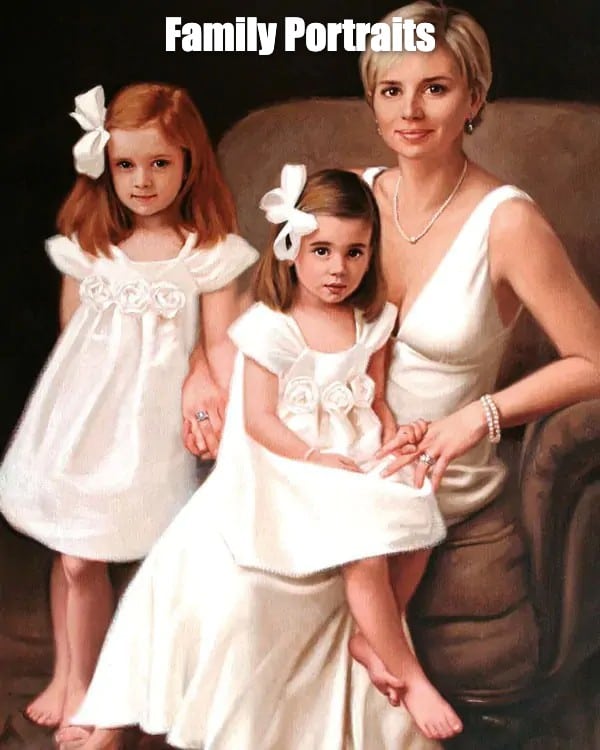
Commissioning a Portrait in Denver
Hazel Morgan is a portrait artist serving clients across Denver. With more than 40 years of fine art expertise, she creates hand-painted oil portraits that are treasured as family heirlooms, corporate centrepieces, and lasting memorials. Her work has been commissioned by private collectors, universities, corporations, and public institutions throughout the region.
Clients in Denver benefit from Hazel’s established process for working with distant sitters. Whether you prefer to supply photographs or arrange a sitting, every portrait receives the same meticulous attention to detail that has earned Hazel recognition from prestigious art societies on both sides of the Atlantic.
How a Denver Commission Is Done
The first conversation
Free of charge and free of obligation, by telephone, video call or email. Hazel asks about the subject, the composition, the size and the light in the room. Denver interiors often have very large windows and hard, bright daylight, and the tonal key of the painting has to be decided with that in mind.
Photographs at altitude
Most of Hazel's portraits are painted from photographs, and Denver presents a specific problem worth knowing about. At five thousand feet the light is thinner and much harder than at sea level, so midday sun blows out the highlights and fills the eye sockets with black. The hour after sunrise and the hour before sunset are transformative here, as is any open shade. Snow makes a superb natural reflector as long as the subject is kept out of direct sun. Several photographs can be combined, and a live sitting is possible where practical.
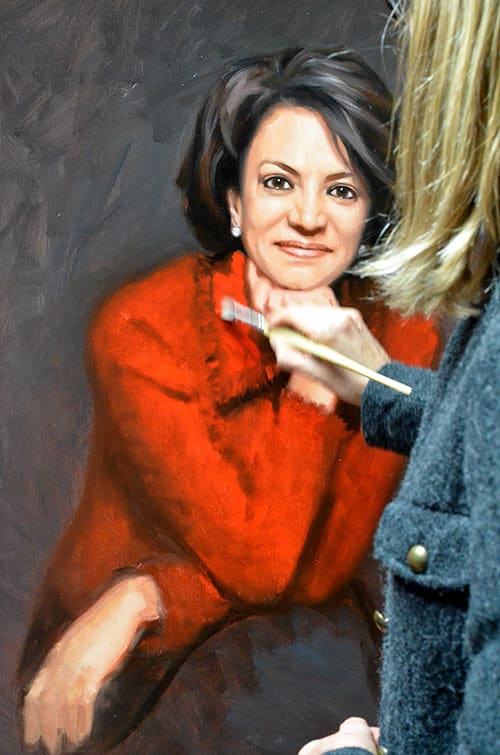
At the easel
Six to twelve weeks according to complexity, with progress photographs at the points where an adjustment is still straightforward.
Framing and delivery
Finished paintings usually arrive in Colorado within one to two weeks. Framing and shipping are quoted on completion, and Hazel will recommend framers if you want the frame chosen for the painting.
Why a Painting Rather Than a Photograph
Colorado has a long habit of preferring the painted version of things. The mountains themselves entered American culture as paintings before most people had seen a photograph of them, and the same logic holds at domestic scale: a painting is an interpretation, made slowly, by someone paying close attention. What Hazel brings:
- Over forty years in practice, with several hundred commissions completed.
- Work shown with the Royal Society of Portrait Painters and the Royal Institute of Oil Painters.
- The same pair of hands from the first drawing to the final varnish, with no assistants involved.
- Progress images throughout, and revisions until the likeness is right.
Questions from Denver Clients
No. Hazel works principally from photographs, which is why commissioning from Colorado is straightforward. A live sitting can be arranged where it is practical, but it is seldom required.
They can, and it is a common request here. Send landscape photographs taken in the same light as the photographs of the sitter, otherwise the figure and the setting will fight each other. Hazel will advise on how much of the view the composition can carry.
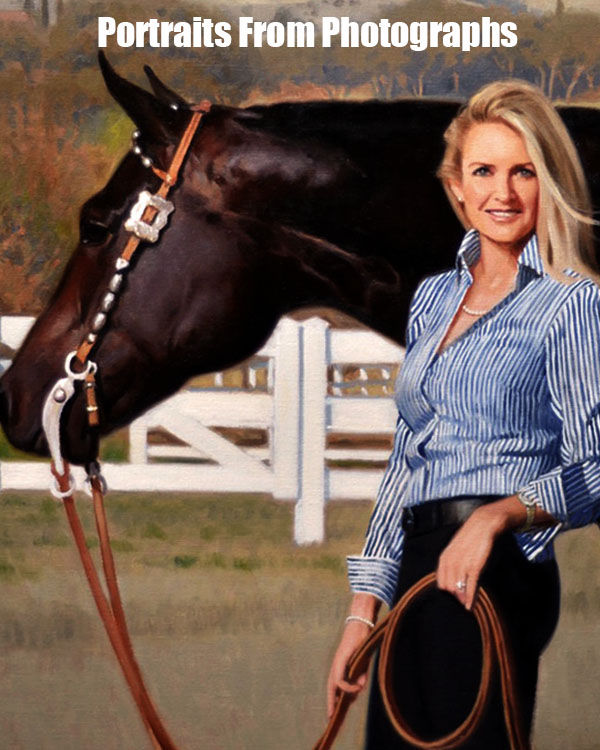
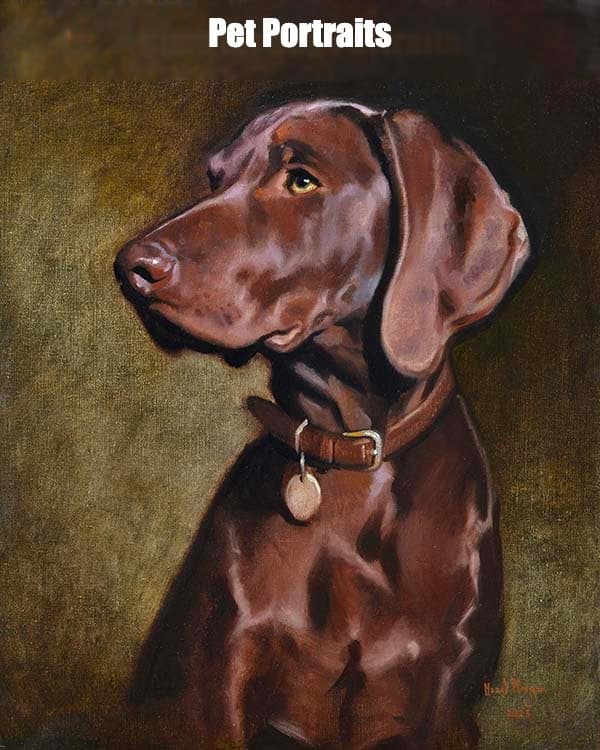
Yes, and they are among her most frequent commissions. Both are painted from photographs. Shoot at the animal's own head height, in soft early light, somewhere it is settled.
The wall and the viewing distance decide. Photograph the room with a door or a chair in shot for scale and Hazel will advise at the consultation.
In crating built for that canvas, by insured courier, to your address, usually one to two weeks after completion. Shipping and framing are quoted separately.
There is more on sittings, sizes and timings on the frequently asked questions page.
Why Hazel Loves Denver
Hazel admires Denver for its rare and wonderful combination of rugged honesty and quiet sophistication. There is something deeply genuine about the people here — a no-nonsense warmth that feels entirely its own, shaped by wide skies, high altitude, and a history built on resilience. Hazel often says that Denver's residents carry their stories visibly, in the lines of their faces and the steadiness of their eyes, and that quality makes her work as a portrait painter feel especially meaningful. When she sits across from a Denver client, she rarely has to search hard for character — it tends to announce itself naturally, the way the Rockies do on a clear morning.
Hazel loves the cultural richness that pulses through the city, particularly around the Golden Triangle neighbourhood, which is home to the Denver Art Museum. She has spent quiet afternoons wandering its galleries, absorbing how light falls across different mediums and how artists across centuries have approached the challenge of rendering a human presence on a flat surface. Those visits feed her own practice in ways that are hard to put into words but easy to see in her finished portraits. The creative energy of that part of the city reminds her that art isn't a luxury — it's simply how thoughtful people make sense of being alive.
Hazel also admires the spirit of neighbourhoods like RiNo, the River North Art District, where murals climb entire building faces and working studios sit beside coffee shops and music venues. There is an unpretentiousness to RiNo that she finds deeply encouraging — a sense that creativity belongs to everyone and doesn't need to be precious or guarded. It aligns beautifully with the way she approaches portraiture: accessible, human, and rooted in genuine connection rather than performance.
Hazel also loves the generosity she consistently encounters in her Denver clients. They show up to sittings open, curious, and willing to be seen — which is, honestly, the greatest gift a subject can offer a portrait artist. That trust is never something Hazel takes lightly. It is what allows her to paint not just a likeness, but a real and lasting piece of someone's life, and Denver, more than almost anywhere she has worked, gives her that gift again and again.
Discuss a Denver Portrait
The first conversation is free and commits you to nothing. Tell Hazel what you have in mind and she will send a quotation prepared for your painting.
Request a Free ConsultationDenver Neighbourhoods and Towns Hazel's Clients Live In
Cherry Hills Village, Greenwood Village, Hilltop, Crestmoor, Polo Club, Belcaro, Bonnie Brae, Cory Merrill, Washington Park, Observatory Park, University Park, Congress Park, Country Club, Cheesman Park, Platt Park, Highlands, Berkeley, Sloan's Lake, Lower Downtown, Park Hill, Englewood, Littleton, Centennial, Lone Tree, Castle Pines, Castle Rock, Parker, Highlands Ranch, Ken Caryl, Morrison, Evergreen, Conifer, Golden, Genesee, Arvada, Westminster, Broomfield, Louisville, Superior, Lafayette, Boulder, Niwot and Longmont.Bierstadt, Clyfford Still and the Denver Portrait
Denver's relationship with painting began as a promotional exercise and turned into art history. In 1863 Albert Bierstadt came west and painted the Rockies at enormous scale for eastern audiences who had never seen them. His canvases were exhibited as events, with curtains and gaslight, and they did more to fix the image of Colorado in the American mind than any photograph of the period. He named a peak after his wife and painted it as Mount Rosalie. A place introduced to the world through oil paint tends to keep some respect for the medium.
The Denver Art Museum is where that thread continues, and its buildings are worth the visit on their own. The 1971 North Building is by Gio Ponti, the Milanese architect, and it is the only building he completed in North America: a twenty-four-sided fortress faced in a million grey glass tiles. Daniel Libeskind's titanium Hamilton Building arrived in 2006. Inside are the Petrie Institute of Western American Art and one of the finest collections of Native arts anywhere, a great deal of which is portraiture made on terms that owe nothing to European convention and repays slow looking.
Two streets away is something no other city has. When Clyfford Still died in 1980 he left almost his entire output, some three thousand works, sealed on the condition that it go to a single American city that would show it and nothing else. Denver accepted, and the Clyfford Still Museum opened in 2011. Whatever you make of abstraction, a museum devoted to the complete life's work of one painter is an education in what sustained single-mindedness looks like.
Denver's older money built accordingly. The Brown Palace opened in 1892, the Denver Country Club in 1887, and the mansions of Capitol Hill went up on silver and railroad fortunes in the same decades. The Byers-Evans House and the Molly Brown House survive from that period and both keep family portraits on the walls, which is where they were always meant to be. The Kirkland Museum a few blocks north holds Vance Kirkland's own paintings alongside a decorative arts collection, and the State Capitol keeps its gallery of governors.
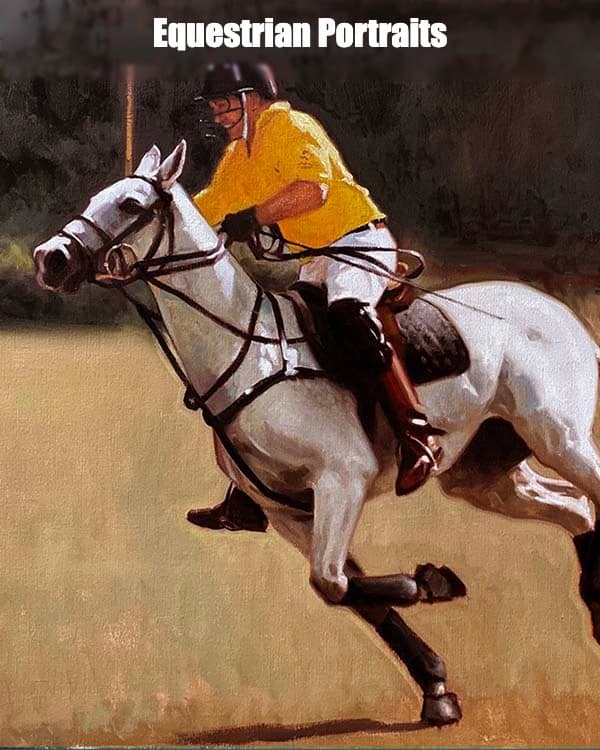
Beyond the suburbs the subject changes. The National Western Stock Show has been held in Denver every January since 1906, and the ranching counties that come into town for it are serious about their animals. Equestrian and stock portraits from the Front Range and the Western Slope are commissioned by people who can tell whether the conformation is right, which is exactly the kind of client a painter should want.
The houses set the last part of the brief. Front Range architecture has always been about light and view, from the 1890s foursquares of Park Hill to the glass-heavy houses of Cherry Hills and the mountain properties above Evergreen. Big windows mean strong, cool, directional light, and a portrait hung in that light has to be painted to withstand it rather than to flatter under a lamp.
What a Denver portrait tends to need, in the end, is clarity. Clean light, an unfussy setting, a straight and un-self-conscious likeness. It suits the place, and it is a good deal harder to paint than grandeur.
